
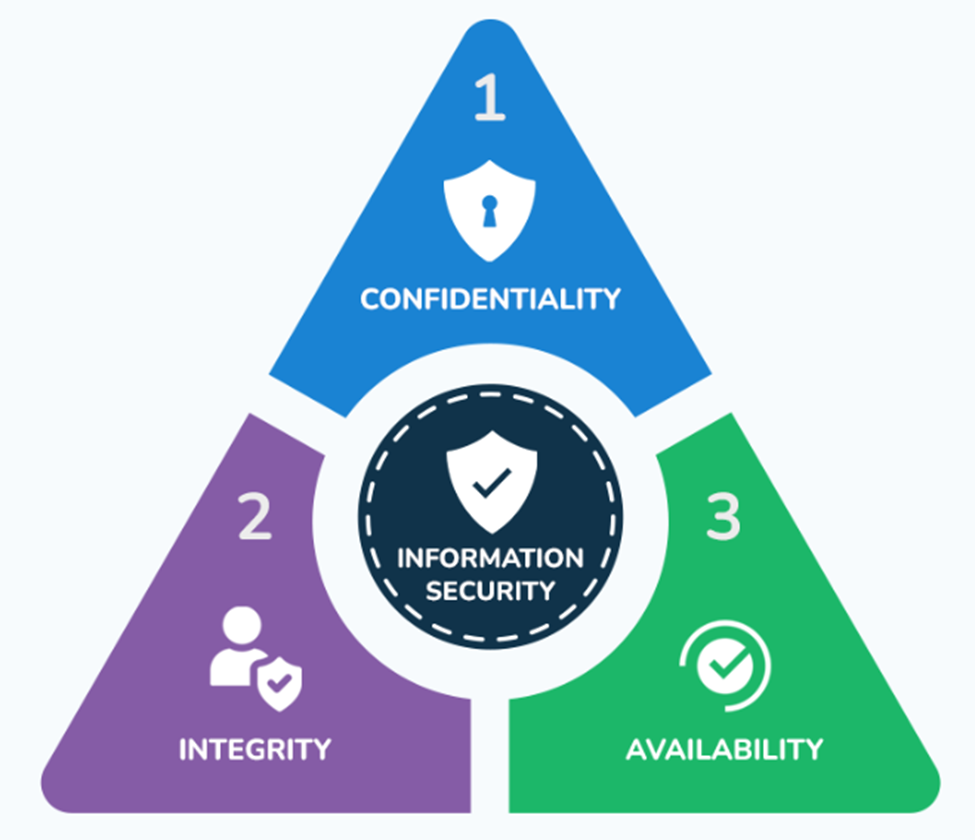
Modern information security rests on three pillars known as the CIA triad: Confidentiality, Integrity, and Availability. Tech leaders need to grasp these core principles that serve as the foundation for building resilient security systems in their organizations.
The CIA triad represents a complete model that shapes information security policies. Each component of this framework plays a vital role. Organizations that implement these elements correctly can strengthen their security stance and handle threats better. Security experts have used these concepts since the early days of computing. The CIA principles combine ideas from multiple sources to create a unified security approach. Leaders who understand CIA triad security gain more than just compliance. They receive a clear, complete checklist to assess their response plans during security breaches.
This piece will take you through each part of the CIA triad with real-world examples. You’ll learn why these principles matter so much to organizations that want to protect their digital assets.
Understanding the CIA Triad in Information Security
The CIA triad might sound like something from a spy movie, but it’s actually a basic framework that shapes cybersecurity practices. This model serves as the foundation that helps organizations create effective information security policies.
What is the CIA Triad? Definition and Purpose
The CIA triad stands as a globally accepted security model that guides organizational IT security policies. The model offers a well-laid-out framework that promotes responsible information handling—something vital to modern business operations.
These three pillars of the CIA triad definition come together to create a detailed security approach:
- Confidentiality: Preserving authorized restrictions on information access and disclosure, including means for protecting personal privacy and proprietary information
- Integrity: Guarding against improper information modification or destruction while ensuring information non-repudiation and authenticity
- Availability: Ensuring timely and reliable access to and use of information by authorized users
These three principles are the foundations of any organization’s security infrastructure and protect data from unauthorized access and manipulation.
Origins of the CIA Triad in Cybersecurity
The CIA triad doesn’t have a single creator, unlike many basic concepts in information security. Security professionals developed it gradually as shared knowledge. Some sources credit the United States Department of Defense with its development at the time of the late 1970s.
The U.S. Air Force study possibly formalized computer science confidentiality in 1976. A 1987 paper outlined integrity by recognizing commercial computing’s specific needs around data correctness. The Morris worm brought availability into focus in 1988. This early widespread malware knocked much of the early internet offline.
Why Tech Leaders Should Care About CIA Triad Security
The CIA triad helps meet regulatory compliance requirements. Companies must adopt CIA principles in their information security programs to comply with GDPR, HIPAA, and PCI DSS regulations.
The framework acts as a central point for managing complex risk analysis and security measures. It helps create solutions and identify vulnerabilities, particularly during security incidents.
The CIA triad also provides a clear checklist to assess incident response pl ans during breaches. Teams can identify threats, risks, and system vulnerabilities more easily by analyzing security measures against these three components.
Confidentiality: Keeping Sensitive Data Private
Data protection’s life-blood lies in confidentiality within the CIA triad framework. The system will give authorized users the ability to access sensitive information through protective measures and systematic controls.
Access Control Mechanisms and Role-Based Permissions
A resilient access control system protects sensitive data. Role-Based Access Control (RBAC) assigns permissions based on job functions instead of individual identities. This simplifies management and enforces the principle of least privilege. Studies show RBAC reduces security incidents by up to 75% by limiting user access to essential functions. Organizations use Mandatory Access Control (MAC) in environments that need stringent security through centralized authority. Discretionary Access Control (DAC) helps resource owners maintain direct control over access permissions.
Data Encryption and Multi-Factor Authentication (MFA)
Encryption changes readable data (plaintext) into unreadable format (ciphertext). Users need specific keys to decode this information. Protection works in three vital areas: data in transit, data at rest, and end-to-end communications. Unauthorized personnel cannot decode intercepted information without proper keys.
Multi-factor authentication substantially strengthens confidentiality with at least two verification factors. Microsoft research shows MFA would have stopped 99.9% of account compromises. These factors typically combine something users know (password), have (device), or are (biometrics).
Common Threats: Insider Leaks and MITM Attacks
Insider threats create major risks as 65-70% of security incidents come from internal sources. Man-in-the-middle (MITM) attacks happen when malicious actors intercept communications between two parties. They capture credentials or manipulate data exchanges. These threats show why layered security approaches in the CIA triad remain vital.
CIA Triad Examples: Confidentiality in Healthcare Systems
Healthcare systems illustrate CIA triad confidentiality requirements through HIPAA regulations. Electronic Protected Health Information (ePHI) must remain available only to authorized personnel. Healthcare organizations use role-based access, biometric verification, and specialized encryption to protect patient data. Laboratory technologists see only relevant test results instead of complete medical histories through customized access.
Integrity: Ensuring Data Accuracy and Trust
Integrity as part of the CIA triad definition focuses on data accuracy and trustworthiness throughout its lifecycle. Data with integrity stays complete, authentic, and remains unaltered by unauthorized parties.
Hashing and Checksums for Data Validation
Hash functions verify data integrity by creating unique fixed-size values from input data of any size. These hash values become digital fingerprints for files and messages. A single bit change to data completely transforms the resulting hash and makes tampering detection easy. SHA-256 produces a 256-bit output, while MD5 generates a 128-bit hash. The chance of two different inputs producing similar hash values (called collisions) with SHA-256 remains astronomically small, which makes it reliable for security applications.
Digital Signatures and Non-Repudiation Techniques
Digital signatures go beyond simple hashing and add authentication and non-repudiation capabilities to the CIA triad security framework. The sender’s private key encrypts a document’s hash value through public key cryptography. The recipient decrypts the signature using the sender’s public key and compares it to a newly calculated hash. This verification process confirms the document’s integrity and its origin. Non-repudiation makes sure that senders cannot deny sending the document because digital signatures uniquely identify them.
Version Control and Audit Trails in Enterprise Systems
Version control systems protect data integrity by tracking changes to datasets, data models, and schemas over time. Organizations can monitor modifications, keep historical records, and ensure reproducibility in data-driven projects. Audit trails create a chronological record of system activities that provide documentary evidence of processing and help detect security violations. These trails serve as operational support and insurance policies that let administrators identify exact modification times and their sources.
Availability: Keeping Systems and Data Accessible
Availability stands as the third pillar of the CIA triad. This means authorized users can access information systems and data whenever they need it. The most secure and accurate data becomes useless if users can’t access it when they need it.
Redundancy, Failover, and RAID Configurations
Redundancy helps you avoid system failures by creating copies of critical components. RAID (Redundant Array of Independent Drives) technology spreads data across multiple drives and gives you better performance and protection. RAID 1 creates exact copies of data for reliability. RAID 5 gives you a good mix of speed and protection through distributed parity. RAID 6 can handle multiple drive failures because it uses double parity. Systems with failover capabilities switch to backup systems automatically when something goes wrong, which keeps services running. High availability systems can achieve 99.999% uptime – you’ll only see about five minutes of downtime each year.
Disaster Recovery Planning and Backup Strategies
A complete disaster recovery plan needs regular backups and clear steps to restore data. The 3-2-1 backup strategy is accessible to more people now – keep three copies of your data on two different types of storage and one copy somewhere else. Your backup schedule should match your recovery point objectives (RPOs), and your restoration process needs to meet recovery time objectives (RTOs). It’s worth mentioning that having redundant systems doesn’t replace the need for good backups.
Mitigating DoS and Ransomware Attacks
Denial of Service (DoS) attacks try to make systems unavailable by overloading servers or using up bandwidth. Ransomware locks up your files and asks for money to unlock them. You can protect yourself by keeping encrypted backups offline where ransomware can’t reach them. Your organization should use storage solutions that prevent anyone from changing backup data without permission.
CIA Triad Examples: Availability in E-commerce Platforms
E-commerce businesses that run around the clock need rock-solid availability. Short outages can be expensive – the 2023 Uptime Institute survey shows this is a big deal as it means that severe outages cost more than $100,000, and 16% cost over $1 million. Online stores stay running by spreading their systems across different locations and copying data between them in real time. This setup helps them keep going even if hardware fails or natural disasters strike.
Bringing It All Together: The CIA Triad as Your Security Foundation
This piece explores how the CIA Triad gives tech leaders a detailed security framework. Confidentiality, integrity, and availability are not just theoretical concepts – they are the foundations of protecting our organization’s most valuable assets.
Security threats evolve faster than ever before. A solid grasp of these fundamental elements gives us the tools to make smart decisions about our security architecture. The CIA Triad serves as a clear checklist to assess existing protocols and spot potential vulnerabilities before they become critical problems.
Companies that build strong CIA Triad principles into their operations face fewer security incidents. They bounce back faster when breaches happen. These concepts need to become part of our security culture rather than just items on a compliance checklist.
The CIA Triad teaches us that good security needs balance. Too much focus on confidentiality can hurt availability. Prioritizing availability might put integrity at risk. The right balance depends on your organization’s specific needs, risk tolerance, and regulatory requirements.
Tech leaders must do more than understand these principles. We need to turn them into practical policies, train our teams, and apply them consistently across all systems. The digital world will change without doubt, but the CIA Triad remains our foundation to build resilient security frameworks that protect our organization’s digital assets today and tomorrow.
FAQs
The CIA Triad is a fundamental security model consisting of Confidentiality, Integrity, and Availability. It’s crucial in cybersecurity as it provides a framework for developing robust security systems, guiding policies, and helping organizations protect their digital assets effectively.
Confidentiality ensures that sensitive data remains private and accessible only to authorized individuals. This is achieved through access control mechanisms, data encryption, and multi-factor authentication, protecting against threats like insider leaks and man-in-the-middle attacks.
Integrity focuses on maintaining the accuracy and trustworthiness of data. It employs techniques such as hashing, digital signatures, and version control to ensure that data remains complete, authentic, and unaltered by unauthorized parties throughout its lifecycle.
Availability ensures that authorized users can access information systems and data when needed. It involves implementing redundancy, failover mechanisms, disaster recovery planning, and strategies to mitigate threats like DoS attacks and ransomware, keeping systems operational and data accessible.
In healthcare systems, the CIA Triad is crucial for protecting patient data. Confidentiality is maintained through role-based access and encryption of electronic Protected Health Information. Integrity is ensured via digital signatures and audit trails. Availability is achieved through redundant systems and robust backup strategies, ensuring continuous access to critical medical information.
